
Invited Speakers
Dr. Juraj Kajan
University of Žilina, AT Crystals
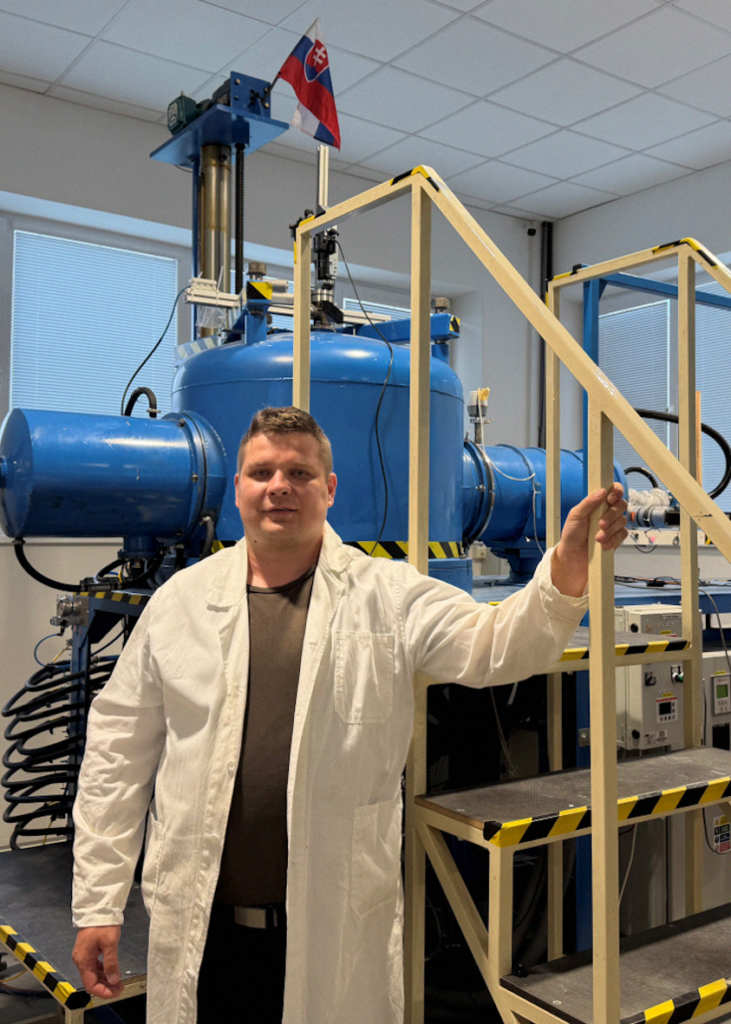
Ing. Juraj Kajan, PhD. – has been working in the field of crystal growth research using horizontal crystallization since 2014, when he was a young student at the time. At the engineering level, his work was dedicated to the topic “Design of a pyrometer movement mechanism for measuring high temperatures”, which was used to measure the temperature of the heater and the melt in the crystallizer. His dissertation dealt with the topic “Research into the possibility of increasing the dimensions of the thermal node of a device used for growing single crystals using the horizontal crystallization method”. Today, his primary focus is on growing doped YAG single crystals via the HDC method. He works as the head of the department at the University of Žilina in Žilina and CTO at AT Crystals company.
Presentation title: Possibilities of the Horizontal Directed Crystallisation (HDC) growth method for sapphire, Re:YAG and eutectic ceramics
Dr. Karol Bartosiewicz
Institute of Physics of the Czech Academy of Sciences

Accomplished physicist and chemist specializing in luminescent, scintillating, and photoconversion materials, with expertise in advanced materials science and crystal growth. Born on July 23, 1989, in Poland, he began his research career at the University of Wrocław, where he worked as a University Research Assistant in the Faculty of Chemistry from 2012 to 2013, gaining experience in the synthesis and characterization of novel luminescent materials.
In 2013, he joined the Marie Curie Initial Training program within the European Network on Luminescent Materials in Prague, developing expertise in energy transfer, luminescence quenching, defect engineering, and optically active garnet single crystals. He later served as an Assistant Professor at Tohoku University’s Institute for Materials Research in Japan, conducting research on crystal growth and scintillation processes.
From 2019 to 2024, he was an Assistant Professor at Kazimierz Wielki University in Bydgoszcz, Poland. Since September 2024, he has been an MSCA Postdoctoral Fellow and EU-funded Principal Investigator at the Institute of Physics of the Czech Academy of Sciences in Prague. His current research focuses on oxide single-crystal growth, advanced luminescent and scintillating materials, innovative crystal-growth methods, and material optimization.
Presentation title: Structure-dependent near-infrared luminescence of Fe3+ in single and eutectic oxide crystals
Dr. Nadiia Rebrova
Institute of Low Temperature and Structure Research
Dr. Nadiia Rebrova is a materials scientist specializing in luminescent and scintillation materials, with particular expertise in rare-earth-doped phosphors, upconversion luminescence, persistent luminescence, and optical thermometry. She received a Master’s degree in Chemistry from V.N. Karazin Kharkiv National University (Ukraine), and in 2018 defended her PhD n Materials Science at the Institute of Scintillation Materials of the National Academy of Sciences of Ukraine.
Since 2022, she has been working at the Institute of Low Temperature and Structure Research of the Polish Academy of Sciences in Wrocław, where her research focuses on the discovery and characterization of novel ultraviolet-emitting phosphors, particularly Pr3+-activated materials for UVC upconversion, persistent luminescence, and photonic applications.
Dr. Rebrova has authored more than 50 peer-reviewed scientific publications in leading journals, including Inorganic Chemistry, Journal of Physical Chemistry C, Journal of Materials Chemistry C, Dalton Transactions, and other. She is the principal investigator of several research projects funded by the National Science Centre (Poland) and international facilities, including DESY (Germany).
Her scientific achievements have been recognized with the President of Ukraine Prize for Young Scientists (2018). She is also an inventor and co-inventor of several patents in the fields of luminescent and scintillation materials.
Research interests: luminescent materials, scintillators, rare-earth spectroscopy, upconversion processes, persistent phosphors, optical thermometry, crystal growth, and advanced inorganic synthesis.
Presentation title: Ultraviolet Luminescence of Praseodymium-Doped Wide-Bandgap Phosphors: Spectroscopic Properties, Luminescence Mechanisms, and Applications
Dr. Stanislav Balabanov
Ludwig-Maximilians-Universität München
Dr. Stanislav Balabanov is a Senior Scientist at the Crystal Laboratory, Chair of Experimental Physics — Laser Physics, Ludwig-Maximilians-Universität München (LMU), Garching, Germany. He has more than 20 years of research experience in the field of optical ceramics and advanced functional polycrystalline materials.
His research has focused on the development of optical ceramics and ceramic–ceramic nanocomposites, including rare-earth oxide-based materials, through the development of nanopowder synthesis and precursor technologies, powder processing and consolidation, and advanced sintering methods. His expertise also includes diffusion bonding of optical materials and the investigation of their structural, optical, laser, magneto-optical, mechanical, and thermophysical properties. He has led research teams involved in the development of a broad range of new materials and processing methods, several of which were reported for the first time.
Dr. Balabanov is the co-author of 163 scientific publications and 10 patents, with an h-index of 25. His current research is primarily focused on zinc chalcogenide-based optical materials, with particular emphasis on their synthesis, processing, consolidation, and optical and functional properties for laser and other photonic applications.
Presentation title: Growth and doping technologies of zinc chalcogenide gain media for mid-infrared lasers